Menopause Belly Fat: What the Studies Actually Show
By the Wellnyra Editorial Team · This article is for general information and is not medical advice.
Quick answer
Menopause belly fat is real: as estrogen drops, women start storing fat deeper inside the belly, and the body burns less fat for fuel. Crunches won't fix it. What studies support is regular aerobic exercise, more soluble fiber, better sleep and, for some women, hormone therapy. A tape measure tracks progress better than the scale.
Your weight hasn't changed much, but your waistband has. Your arms and legs look the same, yet your belly sticks out in a way it never did. If that sounds familiar, you're not imagining it, and it's not about willpower. Here's what the research actually shows, minus the myths.
In this article
- Why your belly changes in menopause
- Visceral vs. subcutaneous fat
- Is it fat or bloating?
- How to measure your waist
- What actually shrinks menopause belly fat
- Hormone therapy and belly fat
- How long does it take?
- Menopause belly myths
- When to talk to your doctor
- Frequently asked questions
1. Why your belly changes in menopause (even if the scale doesn't)
The short version: fat moves. During the menopause transition, the body shifts where it stores fat, and the belly gets more of it.
The Study of Women's Health Across the Nation (SWAN) tracked US women with body scans for years. Fat gain sped up about 2 years before the final period, roughly doubling, while lean mass started to shrink (Greendale et al., 2019). That's why your clothes can fit differently even when your weight barely moves.
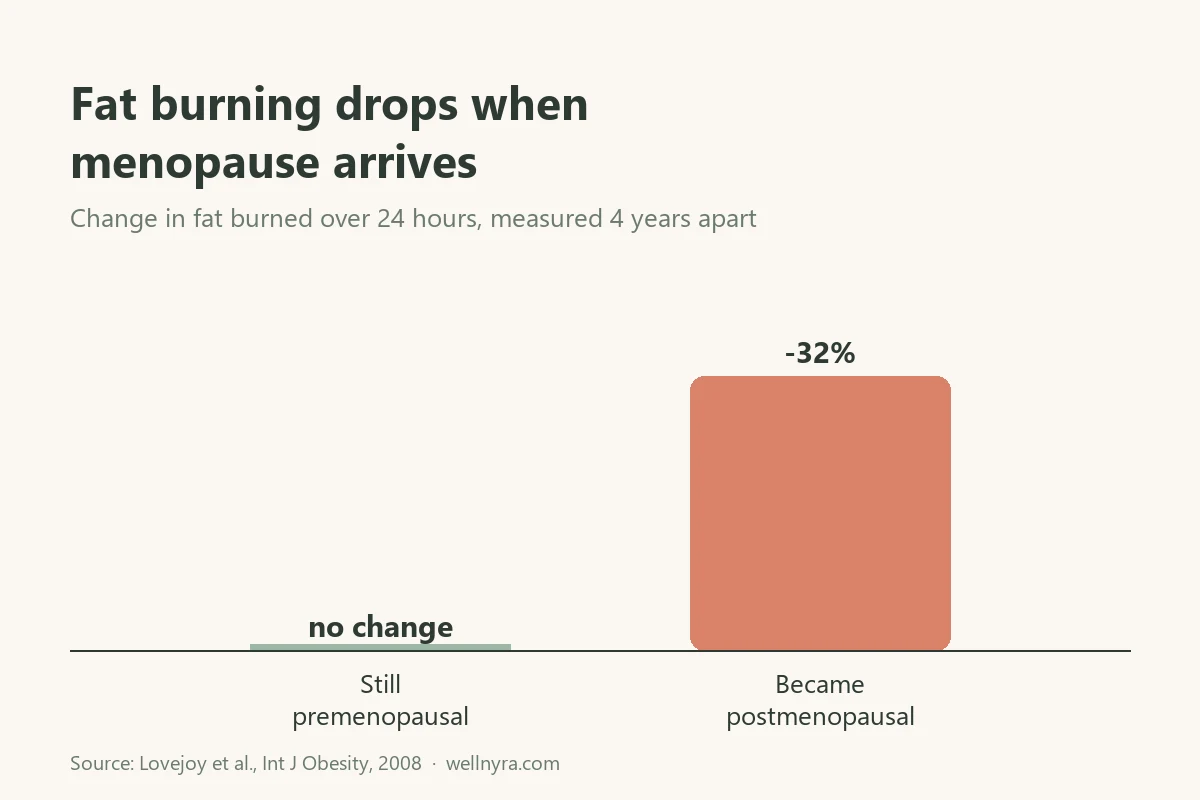
A second study followed 156 women for four years. All of them gained some fat just under the skin of the belly as they aged. But only the women who went through menopause gained deep belly fat, the kind around the organs. Those women also burned less fat for fuel: their fat burning over 24 hours dropped by 32%, while it didn't change in women who were still premenopausal (Lovejoy et al., 2008).
Belly fat is one piece of a bigger picture that also includes muscle loss, less daily movement and worse sleep. We break all of those down in weight gain after 40: 6 real reasons it happens. This article sticks to the belly.
2. Visceral vs. subcutaneous fat: which one is your "meno belly"?
There are two kinds of belly fat, and they're not equal.
- Subcutaneous fat sits just under the skin. It's the soft part you can pinch.
- Visceral fat sits deeper, wrapped around your liver, intestines and other organs. You can't pinch it. It tends to make the belly look rounder and feel firmer.
Visceral fat is the one doctors worry about. Fat concentrated around the middle raises the risk of heart disease and type 2 diabetes (NHLBI), and the American Heart Association has pointed to the body composition changes of the menopause transition as one reason heart disease risk climbs for women after menopause (El Khoudary et al., 2020).
The upside: visceral fat responds to aerobic exercise, as you'll see below. This isn't about looks. Trimming it is one of the best things you can do for your heart.
3. Is it fat or bloating? A simple way to tell
A lot of women call it "meno belly" when part of it is actually bloating. They feel similar, but they behave differently.
| Ask yourself | More likely bloating | More likely fat |
|---|---|---|
| Does it change during the day? | Flatter in the morning, bigger by evening | About the same all day |
| Is it linked to meals? | Gets worse after eating certain foods | Doesn't change much with meals |
| How does it feel? | Tight, full, gassy, sometimes uncomfortable | Soft to pinch, or firm but not uncomfortable |
| How did it show up? | Comes and goes | Built up slowly over months or years |
Many women have both (our guide to bloating after 40 covers the causes and fixes in depth). But one kind of bloating needs attention: if you feel bloated, full too quickly or have belly or back pain for 2 weeks or longer and it's not normal for you, the CDC says to see a doctor (CDC). Most of the time it's something minor, but it's worth ruling out.
4. How to measure your waist (and what the number means)
The scale can't tell fat from muscle, and it can't tell you where the fat is. A tape measure can. Here's how the National Heart, Lung, and Blood Institute says to do it (NHLBI):
- Stand up straight.
- Wrap a tape measure around your middle, just above your hipbones.
- Measure just after you breathe out. Don't suck in.
35+ inches
waist size linked to higher risk for women
Once a month
is often enough to see a real trend
According to the NHLBI, a waist over 35 inches for women raises the risk of heart disease and type 2 diabetes. If you're above it, don't panic. Use it as your starting point. Measure in the morning, before breakfast, at the same spot each time, and write it down. Day-to-day bloating can swing the number, so look at the trend over months, not one reading.
5. What actually shrinks menopause belly fat, according to studies
Here's what the research supports, with what each study actually found.
| Strategy | What the study found | Source |
|---|---|---|
| Aerobic exercise (brisk walking, cycling, swimming) | Reduced visceral fat across 35 randomized trials | Ismail et al., 2012 |
| Strength training alone | No clear drop in visceral fat in the same review, but it protects muscle | Ismail et al., 2012 |
| More soluble fiber | Each extra 10 g a day: visceral fat built up 3.7% more slowly over 5 years | Hairston et al., 2012 |
| Being moderately active | Visceral fat built up 7.4% more slowly than in less active people | Hairston et al., 2012 |
| Crunches and sit-ups alone | 6 weeks of daily ab work: no change in belly fat or waist size | Vispute et al., 2011 |
Make aerobic exercise the base
A review of 35 randomized trials with body scans found that aerobic exercise reduced visceral fat compared with no exercise. The researchers also noted that even amounts below the usual weight-loss recommendations seemed to be enough to help (Ismail et al., 2012). That's encouraging if you're starting from zero.
The US guidelines call for 150 to 300 minutes a week of moderate activity, like brisk walking (ODPHP). Thirty minutes on five days gets you there. Brisk means you can talk, but not sing.

Keep lifting, for a different reason
In the same review, strength training on its own didn't clearly shrink visceral fat. Don't drop it, though. Strength work is what protects your muscle, and muscle loss is a big part of why weight creeps up after 40. The best plan does both: cardio for the belly, strength at least 2 days a week for muscle (ODPHP).
Add soluble fiber
In a five-year study that tracked belly fat with CT scans, people who ate more soluble fiber gained visceral fat more slowly: for every extra 10 grams a day, the rate dropped by 3.7%. Fiber wasn't linked to the fat under the skin, only the deep kind (Hairston et al., 2012). That was an observational study in African American and Hispanic adults, not a trial in women in menopause, so treat it as a strong hint rather than proof.
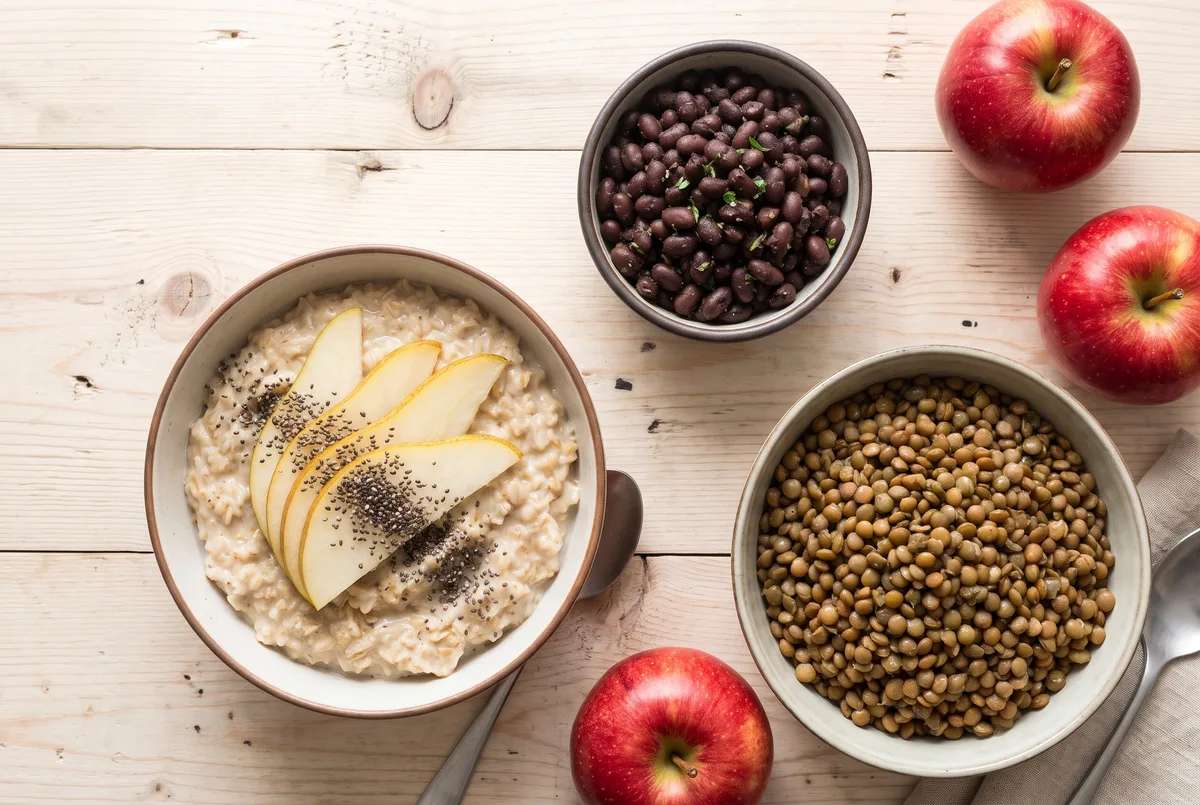
Soluble fiber is the kind that turns gel-like in water. Good sources include oats, beans, lentils, apples, pears, chia seeds and barley. Add it slowly and drink water, or it can make bloating worse at first.
Fix your sleep
Short sleep makes people eat more. In a pooled analysis of lab studies, people ate about 385 more calories a day after sleeping less (Al Khatib et al., 2017). With night sweats in the mix, that's a real problem in menopause. Our guide to menopause sleep and weight gain covers what helps.
6. Hormone therapy and belly fat: what the research says
This is where online advice splits in two, so here's what one of the larger studies found. Researchers in Switzerland scanned 1,053 women aged 50 to 80. Women currently using menopausal hormone therapy had less visceral fat than women who had never used it, and they didn't show the 10-year gain in belly fat seen in the other groups (Papadakis et al., 2018).
Two important limits. First, the benefit wasn't seen in women who had stopped hormone therapy, so it seems to last only while you take it. Second, this was an observational study, so it shows a link, not proof that hormones caused the difference.
Hormone therapy is prescribed for symptoms like hot flashes, not for weight loss, and it isn't safe for everyone. Whether it's right for you depends on your age, your symptoms and your personal and family history. That's a conversation to have with your doctor.
7. How long does it take to lose menopause belly fat?
You'll see specific timelines online, like "12 to 16 weeks." We couldn't find a study behind that number, so here's what the research actually covers:
- Six weeks of daily crunches alone: no change in belly fat (Vispute et al., 2011).
- The aerobic exercise trials that did reduce visceral fat lasted 4 weeks or longer (Ismail et al., 2012).
- The fiber and activity findings played out over 5 years (Hairston et al., 2012).
The honest answer: think in months, not weeks. Measure your waist once a month. If the number is slowly going down, it's working, even when the scale doesn't budge.
8. Menopause belly myths
"Crunches will flatten it"
You can't burn fat from one spot by working the muscle under it. In a randomized trial, people did 7 ab exercises, 5 days a week, for 6 weeks. Their abs got stronger, but belly fat, body fat and waist size didn't change (Vispute et al., 2011). Core work is good for your back and posture. Just don't count on it to shrink your waist.
"A cleanse or a morning drink will melt it"
A cleanse can make the scale and your waistband drop for a few days, mostly from less food and water in your gut. That's not fat loss, and it comes back. None of the studies above used a cleanse, a detox tea or a special morning drink.
"There's a special belly-fat diet"
Visceral fat responds to the same things the rest of your body does: overall eating habits, activity and sleep. The one food pattern with a specific link to visceral fat in the studies above is more soluble fiber.
"A supplement can do it for you"
If you're thinking about a supplement, look at the full label, check the research behind each ingredient, and talk to your doctor if you take any medications. No pill replaces the basics in this article.
9. Perimenopause vs. postmenopause: does the plan change?
The plan is the same. The timing is what's different.
- Perimenopause (often your 40s, periods still coming but changing): this is when the shift starts. In SWAN, faster fat gain began about 2 years before the final period (Greendale et al., 2019). Building the habits now means you go into menopause with more muscle and less belly fat.
- Postmenopause (12 months or more without a period): in SWAN, the fast changes leveled off about 2 years after the final period, but the fat you gained doesn't leave on its own. The habits above still work at this stage, so it's not too late to start.
Talk to your doctor if...
- You feel bloated, full too quickly, or have belly, pelvic or back pain for 2 weeks or longer and it isn't normal for you.
- Your belly grew quickly, or the swelling is on one side or feels hard.
- You have any vaginal bleeding after menopause.
- Your waist is over 35 inches and you haven't had your blood pressure, blood sugar and cholesterol checked recently.
- You're also very tired, cold all the time or constipated (possible thyroid signs).
- You want to know if hormone therapy is safe for you, or you have heart disease, diabetes or high blood pressure and want to start a new exercise plan.
Frequently asked questions about menopause belly fat
References: Greendale et al., JCI Insight 2019 (SWAN), Lovejoy et al., Int J Obes 2008, El Khoudary et al., Circulation 2020 (AHA), Ismail et al., Obes Rev 2012, Hairston et al., Obesity 2012 (IRAS), Vispute et al., J Strength Cond Res 2011, Papadakis et al., J Clin Endocrinol Metab 2018, Al Khatib et al., Eur J Clin Nutr 2017, NHLBI: Assessing Your Risk, CDC: Ovarian Cancer Symptoms, Physical Activity Guidelines for Americans.