Weight Gain After 40: 6 Real Reasons It Happens to Women
By the Wellnyra Editorial Team · This article is for general information and is not medical advice.
Quick answer
Weight gain after 40 usually isn't about willpower or a "broken" metabolism. For most women, it comes from a mix of changes that show up at the same time: perimenopause shifts fat toward the belly, muscle slowly shrinks, sleep gets worse, and daily movement drops. Each one is small. Together, they add up.
If you're eating the same meals you ate at 35 and your jeans still feel tighter every year, you're not imagining it. Here's what research actually shows is going on, and what you can do about each piece.

In this article
- Your metabolism probably didn't "crash" at 40
- Perimenopause moves fat to your belly
- You're slowly losing muscle
- Bad sleep makes you hungrier
- You move less than you used to
- Thyroid problems and medications
- What actually helps with weight gain after 40
- When to talk to your doctor
- Frequently asked questions
1. Your metabolism probably didn't "crash" at 40
This is the most common explanation you'll hear, and it's mostly wrong. In 2021, researchers published a study in Science that pulled together a large database of daily energy use, from babies 8 days old to adults 95 years old. Once they adjusted for body size and muscle, metabolism stayed steady from age 20 to 60. It only started to decline after 60 (Pontzer et al., 2021).
So why does it feel like your metabolism slowed down? Because the things around it changed. You may have less muscle than you did ten years ago, you may move less during the day, and your hormones are starting to shift. Those changes lower the number of calories you burn, even though the "engine" itself is working about the same.
The good news: a metabolism you can't control would be a dead end. Muscle, movement and sleep are things you can work on.
2. Perimenopause moves fat to your belly
Perimenopause is the stretch of years before your final period, when estrogen starts going up and down and then drops. For many women it starts in their 40s. This is where the biggest change happens, and it's less about the number on the scale than about where the weight goes.
The Study of Women's Health Across the Nation (SWAN) followed women in the US for years with body scans. Here's what it found (Greendale et al., 2019):
- Fat mass starts climbing faster about 2 years before the last period.
- The rate of fat gain roughly doubles, from about half a pound a year to about 1 pound a year.
- At the same time, lean mass (mostly muscle) stops growing and starts shrinking.
- About 2 years after the last period, these changes level off.
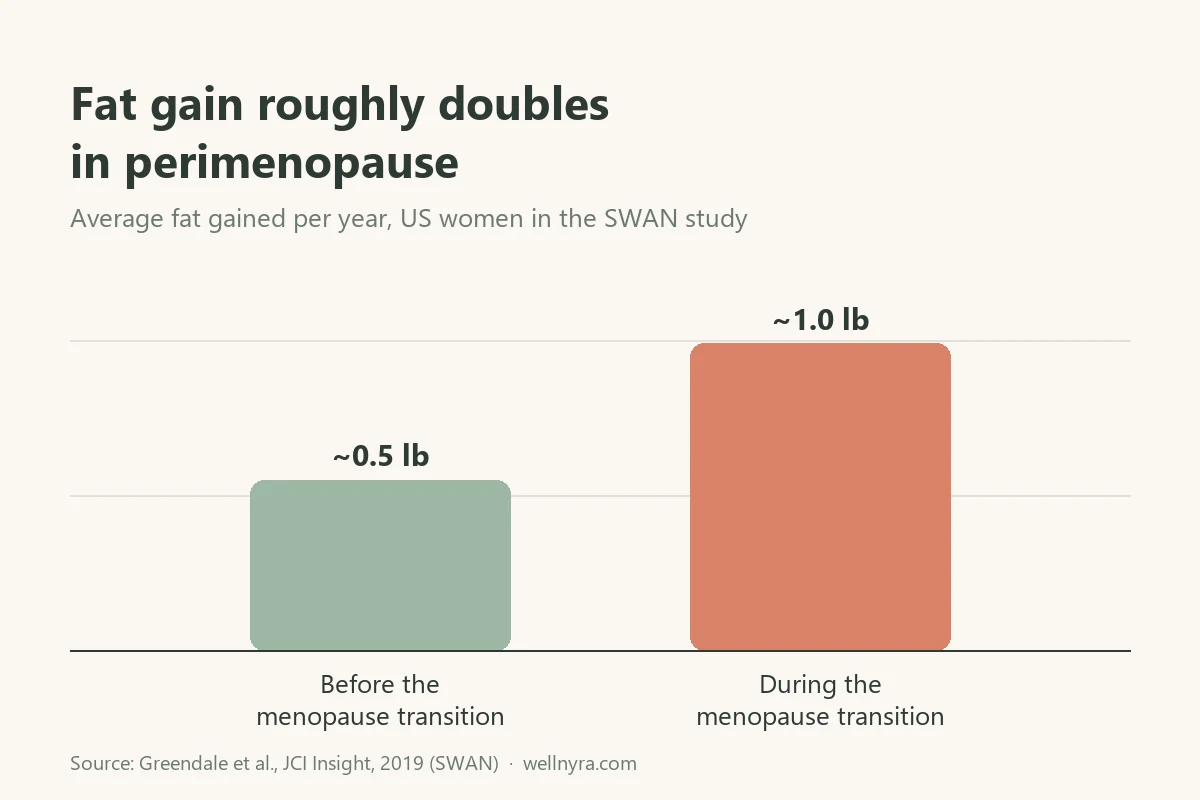
Here's the part that surprises people: in that study, total body weight didn't speed up much. Women were trading muscle for fat. That's why your clothes can fit differently even when the scale barely moves.
Another study followed 156 women for four years and looked at fat deep inside the belly, around the organs (called visceral fat). All the women gained some fat under the skin of the belly as they aged, but only the women who went through menopause gained visceral fat. Those women also burned fewer calories while sleeping and burned less fat for fuel (Lovejoy et al., 2008). We go deeper on this, including how to tell belly fat from bloating, in menopause belly fat: what the studies actually show.
3. You're slowly losing muscle
Muscle burns more energy than fat, even when you're sitting still. And it doesn't stick around on its own. Adults who don't do any strength work lose roughly 3% to 8% of their muscle mass every decade (Westcott, 2012).
Add the muscle loss from perimenopause on top of that, and you can see how a woman in her late 40s can end up burning fewer calories than she did at 35, without changing a single meal.
3 to 8%
muscle lost per decade without strength work
+3 lb
lean weight after about 10 weeks of strength training
+7%
resting metabolic rate in the same studies
That's the encouraging part of the same review. Muscle responds at any age. It just needs a reason to grow.
4. Bad sleep makes you hungrier
If you've started waking up at 3 a.m. for no reason, you have a lot of company. Studies put sleep problems at 40% to 56% of women during the menopause transition and after it, compared with 31% of women a few years earlier (Baker et al., 2018). Night sweats are one cause, but not the only one.
Short sleep changes your appetite hormones. In a small lab study, two nights of short sleep lowered leptin (the "I'm full" hormone) by about 18% and raised ghrelin (the "I'm hungry" hormone) by about 28%. People felt hungrier, and the biggest jump in appetite was for calorie-dense, high-carb foods (think cookies, bread and chips) (Spiegel et al., 2004). That study was done in young men, but it matches what a lot of women notice: a bad night is often followed by a day of grazing.

The CDC recommends at least 7 hours of sleep a night for adults (CDC). If you're regularly getting 5 or 6, fixing sleep may help your weight as much as anything you change on your plate. Here's our full guide to menopause sleep and weight gain.
5. You move less than you used to
This one is easy to miss because it happens without you noticing. A busier job, a longer commute, teenagers who drive themselves now, a sore knee. Fewer steps, fewer stairs, more sitting.
In the four-year study above, physical activity dropped about 2 years before menopause and stayed low afterward (Lovejoy et al., 2008). That timing lines up almost exactly with when fat gain speeds up.
Try this: look at the average daily steps on your phone for the last few months. Many women are surprised by how low the number is.
6. Thyroid problems and medications
Sometimes the cause isn't age at all. An underactive thyroid (hypothyroidism) can cause tiredness and weight gain, and women are much more likely than men to have it (NIDDK). Symptoms alone can't tell you whether you have it. Only a blood test can.
Some medications can also lead to weight gain, including certain antidepressants, steroids and diabetes drugs. If your weight changed soon after you started something new, mention it to your doctor. Don't stop any medication on your own.
What actually helps with weight gain after 40
None of these are quick fixes, and none of them require a special diet. Each one targets one of the causes above.
| What's changing | What helps | A realistic start |
|---|---|---|
| Muscle loss | Strength training | 2 days a week, full body (US guidelines) |
| Less daily movement | Walking and other cardio | 150 minutes a week, about 30 minutes on 5 days |
| Muscle loss, hunger | Enough protein | Some protein at every meal |
| Poor sleep, cravings | Better sleep habits | Aim for 7 hours, same bedtime every night |
| Possible thyroid issue | A blood test | Ask your doctor at your next visit |
Lift something heavy (yes, really)
If you only change one thing, make it this. Strength training is the most direct way to fight the muscle loss behind a lot of weight gain after 40. You don't need a gym. Squats to a chair, wall push-ups, resistance bands and a pair of dumbbells at home are enough to start. The US guidelines call for muscle-strengthening work at least 2 days a week, plus 150 to 300 minutes of moderate activity like brisk walking (ODPHP).

Eat more protein than you think you need
Protein helps you keep and build muscle, and it keeps you full longer. The standard recommendation for adults is 0.8 grams per kilogram of body weight. An expert group on aging suggests more for older adults: 1.0 to 1.2 grams per kilogram a day (Bauer et al., 2013). Their advice is for people over 65, but the idea behind it, protecting muscle as you age, applies in your 40s and 50s too.
For a 160-pound woman, that works out to about 70 to 90 grams a day. Eggs, Greek yogurt, chicken, fish, beans, tofu and cottage cheese all help. If you have kidney disease, check with your doctor first.

Treat sleep like part of the plan
Keep the bedroom cool (it helps with night sweats), cut caffeine after lunch, and keep the same wake-up time on weekends. If hot flashes are waking you up every night, that's worth a doctor's visit. There are treatments that help.
Watch the small stuff
A glass of wine most nights, a couple of extra bites while cooking, a latte instead of black coffee. None of these are a problem by themselves. But when your body is burning a little less than it used to, the small extras matter more than they did at 30.
Talk to your doctor if...
- You gained more than a few pounds quickly without changing how you eat or move.
- You're also very tired, cold all the time, losing hair, or constipated (possible thyroid signs).
- Your weight changed after starting a new medication.
- Hot flashes or night sweats are ruining your sleep.
- Your periods are very heavy, very close together, or you bleed after menopause.
- You have diabetes, high blood pressure or heart disease and want to change your diet or exercise routine.
Frequently asked questions about weight gain after 40
References: Pontzer et al., Science 2021, Greendale et al., JCI Insight 2019 (SWAN), Lovejoy et al., Int J Obes 2008, Westcott, Curr Sports Med Rep 2012, Baker et al., Nat Sci Sleep 2018, Spiegel et al., Ann Intern Med 2004, Bauer et al., PROT-AGE 2013, NIDDK: Hypothyroidism, CDC: About Sleep, Physical Activity Guidelines for Americans.